
Episode 1
Tenkara Fly Tying / Episode 12
The One-Fly Wonder: The Shio Koshō Kebari
- 9 min
- With TJ Ferreira
-
Link copied to clipboard
- Watch on YouTube
- Subscribe on YouTube
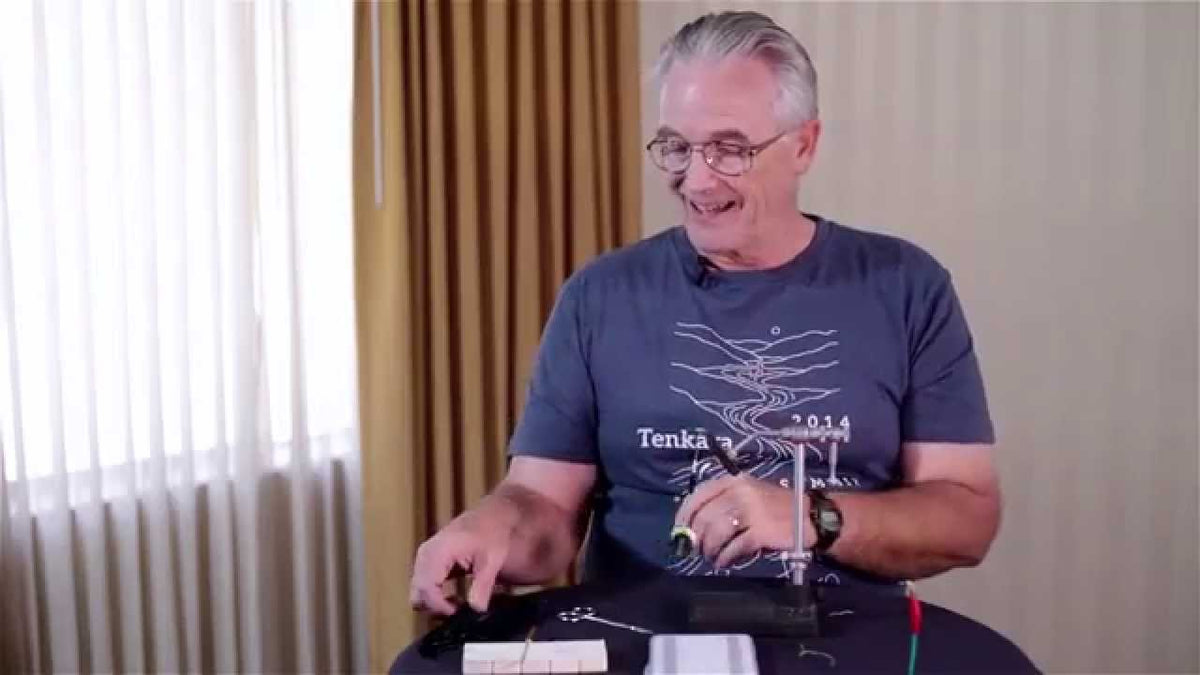
Back in 2010, when Tenkara USA first started, Tenkara USA's own TJ designed the Shio Koshō Sakasa Kebari, or "salt and pepper" kebari as his "one fly". Fifteen years later, we've now made it available to all of you. In this video, TJ walks through the origin of this nifty little fly & his emotional connection to the design, as well as showing us some of the other flies it lives alongside in his kit.
Read the full transcript
INTRODUCTION
Hi, folks. TJ from Tenkara USA here. I thought I'd make a quick little video. We introduced three new flies this last week. It's been what, the last decade, that we've been selling the same four kebari flies? We finally decided, "Hey, we need to come out with a few more and give some folks some other options." One of them is a fly that I created back in 2010 for myself, so I thought I'd make a quick video to explain it.
In a nutshell, our three new flies have been selling wonderfully: the Big Orange, the Little Soft Hackle Olive, and the Shio Koshō Sakasa Kebari, or "salt and pepper." The sakasa kebari is the one I created. They're beautiful little flies, and everything is selling like hotcakes, blowing us away. Since my fly sold out this morning, I thought I'd make a video.
We just introduced them last week, and we made a pretty hefty supply. All of our flies come in these little glass vials, a vial of three flies, and as of this morning mine are sold out. Don't worry, we do have more being made. It's about a two-week back order as of this videotaping. (It's not a videotape, it's digital, right? But I'm an old-timer, so I like to say what I want to say.)
Anyway, I want to thank you. I'm a little bit humbled.
THE ORIGIN OF THE FLY
This is just a fly I created back in 2010, back when Tenkara USA first started. One of the phrases flying around was "one fly." It didn't mean you only carry one literal fly on you, because if you do that and you lose it in a tree, which you will, or on a rock, which you will, or you just lose it because you're trying to tie it on and you're getting old and feeble and can't see the fly, and it drops and you wonder where the heck you dropped it. So "one fly" means one pattern: a pattern that looks basically the same, but that you may tie in various sizes.
Back then I had never tied flies before, and I thought, "Why don't I learn how to tie a fly?" So I learned, and I started playing around with dog hair. We had dogs at the time, may they rest in peace. I have new dogs now that also shed a lot of hair. I tied flies with their hair and such. Then I came up with a pattern, and I looked at it, and I'm a foodie. I love my food. I said, "Salt and pepper sakasa kebari." In Japanese it's "shio koshō sakasa kebari."
WHY I DESIGNED IT
The reason I came up with it is that I have bad eyesight. One eye has a retina or cornea that's kind of shrinking, and I can't really see out of it too well. The other eye isn't doing too well either. I couldn't see a fly underwater, and a lot of the techniques Tenkara folks use involve pulsing the fly under the surface, manipulating it, and presenting it in a way that will entice the fish you're going after. I couldn't see diddly, so I couldn't do anything by sight. I had to go completely by feel, which is kind of cool, because one of the things you want to learn is how to detect those little takes. Tenkara rods are quite sensitive, but you have to learn to tell: is that a take, or just a bump on a rock?
There are visual things about tenkara too, though, and I couldn't see my fly unless it was white, or a very light color, in most waters. So I had an idea: what if I tie the fly with white at the front, so I can see it better? But some days trout are a little finicky. They'll say, "I like a darker bug," or "I like a lighter bug," or just a particular size of bug. So I thought: I need to see it, and the trout needs to see it. Why don't I come up with a two-color idea, white in the front and black in the back? Salt, pepper. Okay, cool.
TYING IT
I grabbed a hook and tied on some white thread, and then I tied a butt made out of black. Once in a while I get a little frisky and tie a little red at the very back too. Those little red hot spots are probably more for us, thinking the trout can see it better, but I may tie a little red on the end once in a while. Normally, though, it's just white and black.
Then I thought: how about the feather? What am I going to do there? You can get some grizzly hackle that's both white and black, and I did that. But then I thought, how about if I take a completely white feather and a completely black feather and wrap them together, using my little hackle pliers, and tie them in at the same time? I liked the look of it because the whole shank of the feather is either white or black, and it gave the fly a really gourmet look. It made it a little more difficult, but I went for it, tied them in, and made my first kebari, my salt and pepper. It looked good.
It's tied in the reverse hackle style, or sakasa kebari. I liked how I could pulse it under the water, and that reverse hackle pulsated because I tied it toward the eye, so every time I tugged on the line, it went. It worked, and I caught fish. My first fish on it, I thought, "I tied a fly that caught a fish. This is awesome!" That's what a lot of you who tie flies feel: that excitement when you've tied a fly that worked.
GOING INTO THE LINEUP
Now, 15 years later, we were thinking of some flies we wanted to sell, and one of them popped up: "TJ, your fly. You've made blog post after blog post, and you made a video on YouTube that shows how to tie it. Why don't we do yours?" I was honored and humbled, so we went for it, and in the first few days they sold out. So thank you very much to those who bought it.
Now, there's no guarantee that it's going to catch fish. You are the one. Don't blame your rod, don't blame your line, don't blame your fly. Blame yourself, or blame the trout. If you don't catch fish, that's your problem. But I will say they are a very effective fly.
I have used that one fly everywhere in the United States, only that one fly, the same pattern. I tie it in 8, 12, and 16. For this particular fly that we're selling on Tenkara USA, we did a 14, because a 14 is a cool size: not too big, not too small, kind of in the middle. It's still a relatively small fly, tied on a scud hook, and we're giving it a go.
I hope that if you present it the right way, you'll catch tons of fish. Whether it's bluegill, crappie, or bass, they work, but they're designed for trout. Mine, the sakasa kebari, pulses under the water, so try some techniques. I hope they catch many fish for you. If they don't, I don't know what to tell you: you need to work on your presentation. That's what I'm telling you.
Thank you very much. I just wanted to make a video. I'm humbled and so excited that my fly is on the list of flies Tenkara USA sells. Hopefully it's there for many years, and hopefully many people have a good time fishing it.
MY FLY BOX
Oh, but I should show you. I grabbed it. This is my beat-up, older Tenkara USA fly box. It holds 12 flies, and it's beaten up and scratched up. I don't know if this will come through. Sometimes the camera likes to focus on a face and not the box, but I'll show it at a few different angles.
This is my box. These are all my ties, not the ones we're selling. You'll see there's one beaded fly in there. I've also got a couple of flies in there from pets that have passed, where I used their fur in a kebari. I don't want to cry now, so I won't, but I feel they're with me all the time. So yeah, I'm crying a little bit. We'll go back to not crying here.
I also tied a beaded fly for the zombie apocalypse, in case I have to catch a fish and need to get down four feet really quickly. I have one beaded fly that I tied up in a similar fashion.
Anyway, that's my fly box. They're just silly flies, but thank you for watching. Now I'm going to walk off camera as I cry a little bit more, because I'm thinking of my passed-away pets. Pets are the greatest thing in the world.
Featured in this video
Shop the video
Keep watching
More from Tenkara Fly Tying
5:37
Episode 2
Tying a Traditional Kebari
8:25
Episode 3
Tying Without a Vise
5:01
Episode 6
Tying Flies with Malcolm Daly
3:08
Episode 7
How to Tie a Royal Conrad
8:58
Episode 8
Simple Fly Tying with Hisao Ishigaki
7:00
Episode 9
Tying Tenkara Flies with Tyekara
2:51
Episode 10
Kurobe-style Fly Tying with Joe Egry
2:05
Episode 11
How to Use a Whip Finisher
Keep watching
Related videos
5:44
Product intro
Introducing the YAMA™ Rod
10:20
Product intro
Introducing the IWANA™ 15th Anniversary Edition
4:55
Product intro
Meet The Tenkara USA UKIYO™ Rod
1:34
Product intro
Meet The Tenkara USA SATOKI™ Rod
3:31
Beginner
Why Tenkara?
Featured series
The Tenkara Masterclass
13:45
Episode 4
How to Read a River & Find Trout
8:23
Episode 5
How to Catch Trout on a Dry Fly

JOIN OUR COMMUNITY
Welcome
Get new Masterclass episodes, tenkara tips and exclusive sales in your inbox.